
Douglas County Projected Release Dates
A projected date is a sentence-computation value. It estimates when confinement may end under the law and facts then recorded. An actual release date records when the person left that custodian. Those dates may match, but they answer different questions. Jail processing, a receiving agency, or a later legal event can separate them.
Douglas County’s active inmate roster does not publish a Douglas County projected release field. It shows current booking and charge information, not a promise about exit. A charge status such as Sentenced or ROR can be a clue, yet neither proves that all processing and holds have cleared. For a Douglas County state-prison case, the MN DOC Public Viewer may show relevant status and date information for a person still under DOC jurisdiction. The current record’s exact label must be preserved.
| Person’s status | Does a computed date exist? | Best source |
|---|---|---|
| Pretrial in Douglas County Jail | Usually no fixed date | Court order, bond status, jail processing, and hold information |
| Serving a county jail sentence | Possibly, after sentence and credits are applied | Sentencing order, jail credit calculation, and jail records |
| Serving a Minnesota prison sentence | Yes, subject to the state computation | MN DOC record, sentencing documents, and applicable statutes |
| Board-jurisdiction case | A projected date may be set after review | Individual board decision, minutes, and DOC record |
Find Douglas County Release Dates
Start with the Douglas County custodian. A person booked only into Douglas County Jail will not gain a reliable Douglas County release date from the state-prison locator. A person transferred into MN DOC custody is no longer a Douglas County Jail computation. Douglas County court records explain the sentence or release direction, while the custodial record explains how the agency applied that order.
For Douglas County matters, call the Douglas County Jail at 320-762-2139 or request existing public data through Sheriff Records. Ask for the Douglas County release date, time, and legal basis if the event already occurred. For a sentence computation, ask what public jail record shows the sentence, jail credit, projected end, and any recorded transfer or hold. The Douglas County release records overview gives the full request chain.
- Determine whether the person is pretrial, serving a county jail sentence, or committed to MN DOC.
- Read the Douglas County court sentencing order and Register of Actions for sentence terms and jail credit.
- For a local sentence, ask the jail which existing public record contains the current computation.
- For a state sentence, search the MN DOC Public Viewer by name and DOC identifier.
- Copy the exact status and date label. Do not rename it “guaranteed release.”
- Check other cases, detainers, disciplinary time, and board authority before relying on the date.
- Confirm the actual event with the agency after the planned date passes.
Note: A Douglas County roster absence is negative evidence only and cannot supply a projected or completed release date.
Douglas County DOC Date Search
The official MN DOC gateway says its locator covers people committed to the commissioner who remain under DOC jurisdiction. That includes people in a state prison and people released from prison while still on community supervision. It does not cover an ordinary Douglas County Jail stay, and it is not a complete historical archive after final discharge.
Search for the Douglas County person with the best name and DOC identifier, then open the individual record. Inventory the literal status, location or supervision entry, sentence information, date labels, and any identifying image before drawing a conclusion. Douglas County research could not confirm a universal field name such as “projected” or “anticipated” across all live records, so the finished page does not invent one.
The manifest’s successful MN DOC Public Viewer capture appears below.
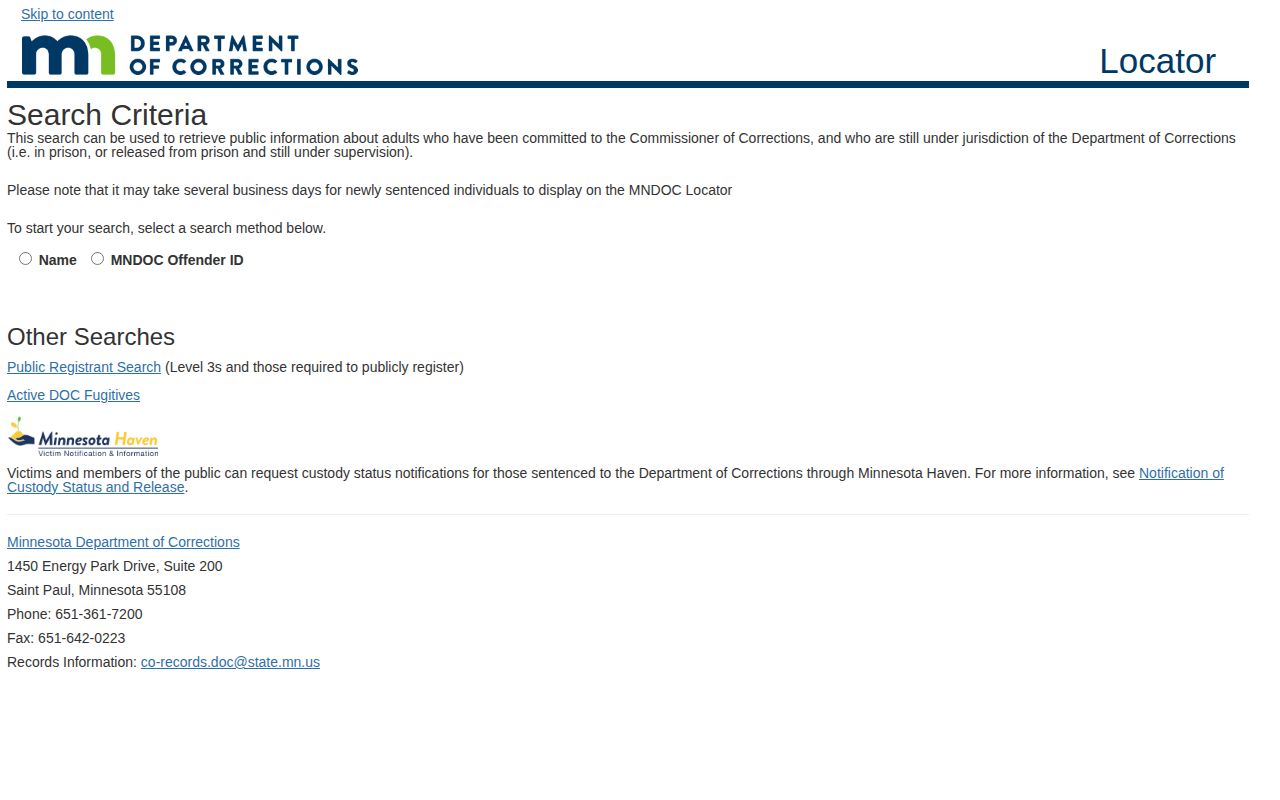
The image demonstrates the official state route, while the matching person’s live record and sentence documents supply the case-specific date.
If the Public Viewer has no matching result, repeat the search with verified spelling and the DOC number. A blank result may reflect final discharge, a scope limit, or an identity mismatch. It does not prove that the person never served a Minnesota prison sentence. DOC Records Management can receive a narrow request for an existing public status history, release record, or final-discharge record when the live locator no longer answers the question.
Douglas County Sentence Structure
Minnesota’s ordinary rule is not an 85-percent rule. For a qualifying fixed executed felony sentence committed on or after August 1, 1993, Minnesota Statute §244.05, subdivision 1b, generally provides a supervised-release term equal to one-third of the sentence, less disciplinary confinement time. In simple, undisturbed arithmetic, this is commonly described as two-thirds imprisonment followed by one-third supervised release.
A clean 36-month illustration would split into about 24 months of imprisonment and 12 months of supervised release. That example explains the statutory structure only. It cannot calculate a real Douglas County case. Jail credit, discipline, earned incentive treatment, concurrent or consecutive terms, conditional-release periods, multiple cases, board jurisdiction, and later legal changes can alter the working date.
- Term of imprisonment
- The confinement portion of the executed sentence after the agency applies governing rules.
- Supervised-release term
- The community portion during which the person remains under correctional authority.
- Jail credit
- Qualifying time credited under the sentence and court record.
- Disciplinary confinement time
- Additional confinement tied to discipline under the governing framework.
Note: Two-thirds and one-third describe the ordinary structure, not a universal prediction for every Minnesota sentence.
Douglas County Earned Release Credit
Minnesota’s earned incentive release framework appears in §244.41 and §244.44. It is plan-based and limited by eligibility. It should not be described as an automatic discount that every person receives. The individual plan, DOC calculation, and applicable law govern.
Discipline or refusal of required programming can add confinement. Earned treatment can affect eligible participants, but §244.05 preserves the statutory supervised-release component in the manner described by subdivision 1b. A calculator that subtracts a flat percentage would miss this interaction as well as jail credit, sentence stacking, and conditional-release terms.
Douglas County jail sentences require a different source. Douglas County does not publish an online good-time or projected-release calculator on its roster. Use the Douglas County sentencing order and ask the jail for the existing computation record. Never estimate the Douglas County release date from the charge level or booking date alone.
Douglas County Release Date Changes
A valid projected date can move without the earlier record being fabricated. The agency may receive a revised court order, apply credit, add disciplinary confinement, identify another sentence, or act on a detainer. A detainer is a request or hold from another authority. It can mean that leaving one facility leads directly into another agency’s custody.
Read each cause through its owning record. The court controls its orders. DOC controls its state sentence computation. The jail can describe local custody and any hold or transfer data it may lawfully disclose. The Supervised Release Board controls decisions only in cases within its statutory jurisdiction.
| Factor | Possible effect | Record to verify |
|---|---|---|
| Jail credit | Changes credited confinement time | Sentencing order and agency computation |
| Discipline | Can add disciplinary confinement time | DOC sentence and disciplinary record |
| Earned incentive release | May affect an eligible, plan-based computation | DOC plan and statutory calculation |
| Concurrent or consecutive sentences | Changes how multiple terms combine | Judgment, warrant of commitment, and DOC record |
| Detainer or hold | Can lead to transfer instead of community release | Custodian and receiving-agency record |
| Board decision | May set, deny, continue, or later revisit a date in covered cases | Individual decision, minutes, and DOC record |
Douglas County Weekend Release Rule
Minnesota law includes a calendar rule that can move the operative day. For covered offenses committed after August 1, 1992, §244.05 states that when the release date falls on Friday, Saturday, Sunday, or a holiday, release begins on the next day that is not Friday, a weekend, or a holiday. Older offenses use different earlier-day handling.
This provision must be applied to the correct offense date and sentence. It is not a general promise that everyone held in Douglas County leaves on the same weekday. A county jail release may also depend on a court order, local processing, and other holds. Confirm applicability with the live statute, the sentence record, and the responsible custodian.
Douglas County Board Release Dates
The Minnesota Supervised Release Board handles limited classes rather than every routine determinate sentence. Its official page says an initial readiness review may occur three years before the projected eligibility date. The board may establish a projected date or continue the case with directives, and it cannot authorize release before the statutory minimum.
The schedule page links upcoming meetings, an updated Review Schedule PDF, agendas, and minutes. The individual decision and DOC record remain necessary for a person-specific date. If a past decision has aged off the posted materials, request the record from DOC instead of guessing from an old calendar.
The official board process page is shown below.
It supports the limited-jurisdiction path and should not be read as proof that every Minnesota prisoner receives a board hearing.
Confirm Douglas County Actual Release
After the projected day arrives, verify the actual custody event. For Douglas County Jail, the Sheriff’s public release record can provide the date, time, and legal basis under Minnesota Statute §13.82. If the record says transfer, the person remained in custody and the next inquiry belongs with the receiving agency.
For Minnesota prison cases, review the DOC status and use Minnesota Haven if the eligible recipient registered for state-prison notices. County-jail VINE does not cover MN DOC prisons. The separate Douglas County VINELink inmate search applies to county-jail alerts, not the state-prison calculation.
A court order and a custody record should be paired when timing is disputed. The order states what the judge directed, while the jail or DOC record reflects processing and physical custody. Another warrant, sentence, detainer, or receiving agency may still prevent community release. This is why a past projected date can coexist with a later actual exit or a direct transfer.
Finally, separate release from discharge. A person may leave prison and remain on supervised release. A discharge order, sentence-expiration record, DOC discharge record, or qualifying legacy certificate is stronger evidence that correctional authority ended. Match identity with at least two stable details whenever possible, and preserve the exact source wording and check time.