
Douglas Jail Release Paths
Douglas County Jail is the principal adult local detention facility in Alexandria. Leaving it can mean release to the community after bail, release on recognizance, time served, dismissal, sentence expiration, or another court order. It can also mean movement to another government custodian. A sentenced felony defendant may enter Minnesota Department of Corrections custody. A boarder or courtesy hold may return to the county that placed the hold. Federal or immigration authorities may take custody, and a juvenile may go to the contracted regional center.
Those events must not be merged under one vague word. A community release means the jail stopped holding the person and no other custodian immediately took over. A transfer means custody continued. Supervised release means prison confinement ended while Minnesota DOC jurisdiction continued in the community. The Douglas County Sheriff release record is the best local source for the date, time, and legal basis on which the jail stopped holding someone. If it says transfer, follow the receiving agency.
| Recorded event | Next place to verify |
|---|---|
| Bail, ROR, time served, or court release | Jail or Sheriff Records for physical exit; court record for the judicial reason |
| Transfer to MN DOC | MN DOC Public Viewer and DOC records |
| Boarder or courtesy-hold return | Originating county or named receiving agency |
| Federal or immigration pickup | Recorded hold, federal court, BOP, ICE, or USMS as applicable |
Confirm Douglas Jail Release
The Active Inmate Roster is only a current-custody starting point. It shows booking and charge facts, but it has no released view, release date, release reason, or rolling recent-release window. A name that no longer appears may reflect release, transfer, a returned boarder, a data update, or an identity mismatch. ROR is a release direction, not proof that jail processing has ended.
Use a branching check instead of treating roster absence as a result. The full Douglas County released-person search and records route is also explained on the Douglas County released inmates home page.
- Search the current roster with the exact name and note its displayed “as of” time.
- Call the jail and ask whether the public record shows physical release or transfer.
- Request the public release date, time, legal basis, and destination agency if a transfer occurred.
- Check the Douglas County court Register of Actions for the order, disposition, warrant, or sentence behind the event.
- If another custodian took over, continue with that agency’s locator or records office.
Douglas Jail Release Records
The jail and Records Division serve different practical roles. The jail can address a current custody or pickup question. Sheriff Records accepts a focused written request for existing public data. Under Minnesota Statutes section 13.82, the date, time, and legal basis of release are public request data at the originating law-enforcement agency. Ask the agency to preserve its literal term, such as ROR, cash bail, time served, court order, or transfer.
Douglas County Jail509 3rd Avenue W
Alexandria, MN 56308
320-762-2139 Douglas County Sheriff Records Division
216 7th Avenue West
Alexandria, MN 56308
320-759-6225
Fax: 320-762-1038
records@co.douglas.mn.us
The Sheriff Records page offers in-person, fax, mail, and email channels plus an official request form. Supply the full name, date of birth if known, booking range, and case or incident number. Ask separately for the release event, transfer destination, booking sheet, custody event log, and booking photograph. Public jail-record copies are listed at $0.25 per page, but confirm charges for electronic, certified, staff-time, or unusual-format work.
Douglas Jail Custody Records
Douglas County describes the jail as a direct-supervision facility that holds male, female, and juvenile inmates across several security levels. It can house boarders and courtesy holds. Those functions make the receiving authority as important as the date a name left the local roster. A transfer out of the building is not the same as release from government custody.
The active roster may show name, booking date and time, charge, arresting agency, and statuses such as Bail Set, Sentenced, ROR, Remand-Custody, Courtesy Hold, Suspense, or Charges Dropped. None is a substitute for the release event. A dropped charge may coexist with another case or hold. Time served can end confinement in one matter while another authority remains. Ask for the complete custody chain when the distinction matters.
- ROR
- Release on recognizance, a court-authorized release subject to conditions and jail processing.
- Boarder
- A person housed for another authority, which may take the person back.
- Detainer
- A request or hold that can prevent community release or cause transfer.
- Final discharge
- The later end of correctional authority, not merely the day a person leaves jail.
Douglas Jail Capacity Records
Two official sources describe the building differently. The county jail page says the facility was built in 2010 at a cost of $12.9 million, measures about 57,000 square feet, has 156 beds, and is approved to hold up to 135 people. A 2025 Minnesota DOC inspection reports an approved secure coed capacity of 149 and a 90 percent operational capacity of 134.10. Physical beds, approved capacity, and operational capacity are different measures, so neither set should be silently substituted for the other.
The sources also render the street direction differently. The county’s current page uses 509 3rd Avenue W, while the inspection uses 509 Third Avenue N. The county presentation is used for contact and pickup. Call before travel if the suffix affects directions. The matching county source image shows the facility page used for its identity and capacity statement.
View the official Douglas County Jail source before relying on a saved facility detail.
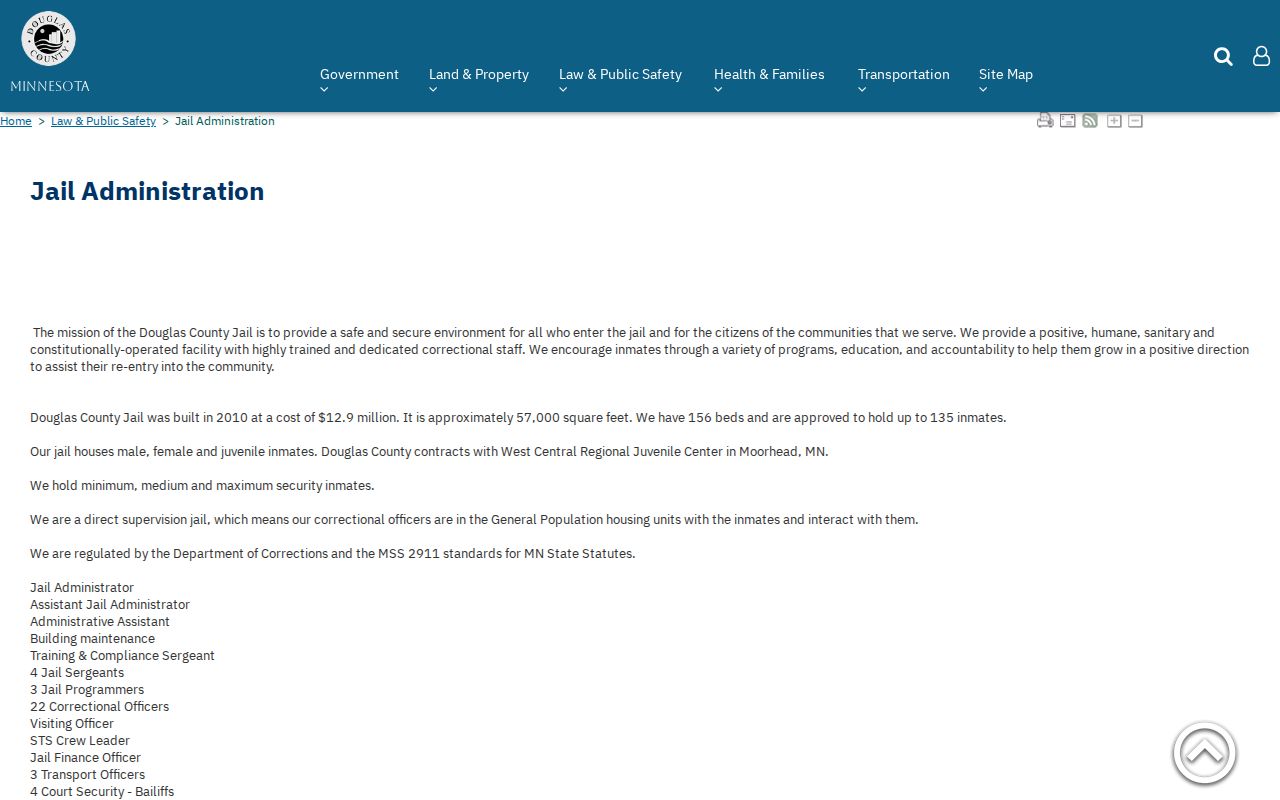
The screenshot supports the county’s own description, while the state inspection remains the source for its separate capacity measure.
Douglas Jail Release Pickup
Douglas County publishes unusually exact exit logistics. Normal daily release begins at 9:00 a.m. Releases do not occur from 7:00 to 9:00 a.m., 11:00 a.m. to 1:00 p.m., or 4:30 to 7:00 p.m. The checking-into-jail instructions say an ROR release averages about one hour after court, though it can take longer. These time blocks describe operations, not a promise for one person.
Pickup is on the west side in the lot between the jail and the SunOpta plant. Released people exit through west-side Door #2128. A family member should confirm status before driving because a court order can precede final processing, and an agency hold can change the path. The county does not publish transit guidance on this source, so no route should be assumed.
Property is inventoried at intake and acknowledged on a signed property log. A person may execute a Property Release to a recipient, but the county says individual items cannot be selected: all property other than original clothing and shoes must be released together. Evidence stays with the arresting agency. Final-exit property details should be confirmed with the jail.
Note: A scheduled pickup time is planning information, while the Sheriff release event is the record of actual physical exit.
Prove Douglas Jail Release
A strong Douglas County release file uses more than one source because each answers a separate question. The Sheriff record proves when the jail stopped holding the person and on what recorded authority. The Minnesota court Register of Actions can show the judge’s order, disposition, sentence, warrant, or discharge. Minnesota VINE can provide an operational county-jail alert, but it is not a permanent certified archive.
Keep identity checks strict. Record the query time, exact spelling, date of birth if lawfully known, booking or case number, and the literal agency wording. If the Sheriff says “transfer,” do not publish “released.” Ask whether the destination and transfer date are public, then verify with that custodian. If telephone staff cannot release information, use the written request form. A phone limitation may reflect policy, staffing, or protected data and does not prove continued custody.
For consequential court use, request a certified order from Douglas County Court Administration. It can establish what the court directed, but the jail record remains the better source for the moment of physical exit. This division prevents a common error: treating a signed order, roster disappearance, or ROR label as if each proved the same event.
Keep copies of the written response and the source timestamp. If official records conflict, report both with their dates and ask the owning agencies to explain the difference.