
Minnesota Prison Release Paths
Minnesota DOC operates state correctional facilities, but the official directory sweep identified none physically located in Douglas County. A Douglas County felony case may still result in commitment to a prison elsewhere. The move from Douglas County Jail to DOC is a transfer and continued custody, not release to the community.
When imprisonment ends, a person may enter statutory supervised release and remain under the commissioner’s legal custody while living in the community. The Alexandria DOC felony office can route local supervision questions. Final discharge or sentence expiration comes later and may cause the person to fall outside the Public Viewer’s stated scope.
Confirm Minnesota Prison Release
The MN DOC Public Viewer covers people committed to the commissioner who are still under DOC jurisdiction, in prison or released to supervision. It is not the source for a jail-only stay. Search with the best name and DOC identifier, then retain each label exactly.
- Open the Public Viewer and enter the strongest available identifiers.
- Compare identity details before selecting a record.
- Read the literal custody, location or supervision, sentence, and date fields.
- Save the query time and DOC number.
- Use DOC Records Management for a public release, status-history, or discharge record when the viewer is insufficient.
The Douglas County released inmates page provides the separate Sheriff route for a local jail release.
Minnesota DOC Release Records
DOC Records Management accepts requests for existing public data. Ask for the person’s release or discharge record, literal status history, or final-discharge material. Do not ask the agency to create a date calculation or legal analysis it does not maintain. Minnesota corrections data law permits withholding of private medical, psychological, security, informant, and other protected information.
Minnesota DOC Records Management1450 Energy Park Drive
St. Paul, MN 55108
651-361-7330
Fax: 612-473-5006
CO-Records.DOC@state.mn.us
The official DOC Data Practices page is the source for current request methods. A court sentencing or discharge order answers a judicial question, while the DOC record answers correctional custody and supervision.
Minnesota DOC Viewer Scope
The Public Viewer is not a full historical prison archive. Its official gateway says it covers people still under DOC jurisdiction. A person on supervised release can therefore appear after prison exit, while a fully discharged person may no longer appear. A no-result may also reflect spelling, identifier, or scope issues.
| Stage | Meaning | Best evidence |
|---|---|---|
| County jail transfer | Custody moved to DOC | Sheriff transfer record and DOC status |
| Prison release | Physical confinement ended | DOC record and exact date label |
| Supervised release | Community placement with DOC jurisdiction | Viewer and supervision office |
| Final discharge | Sentence or correctional authority ended | Discharge record or court order |
Minnesota DOC Release Dates
A future date shown by DOC is contingent. For an ordinary qualifying fixed executed sentence, section 244.05 generally structures imprisonment followed by supervised release equal to one-third of the sentence. The common shorthand is two-thirds confined and one-third supervised, not an 85 percent rule. Jail credit, discipline, earned incentive treatment, concurrent or consecutive terms, conditional-release periods, multiple cases, and legal changes can alter the calculation.
The Supervised Release Board handles limited eligible classes rather than every routine determinate sentence. In covered cases it may establish a projected date or continue review with directives, but cannot release someone before the applicable statutory minimum. Individual DOC records, board decisions where relevant, and sentencing documents control.
Minnesota Offender Search Form
Open the official MN DOC Public Viewer to see its current search form and live field labels.
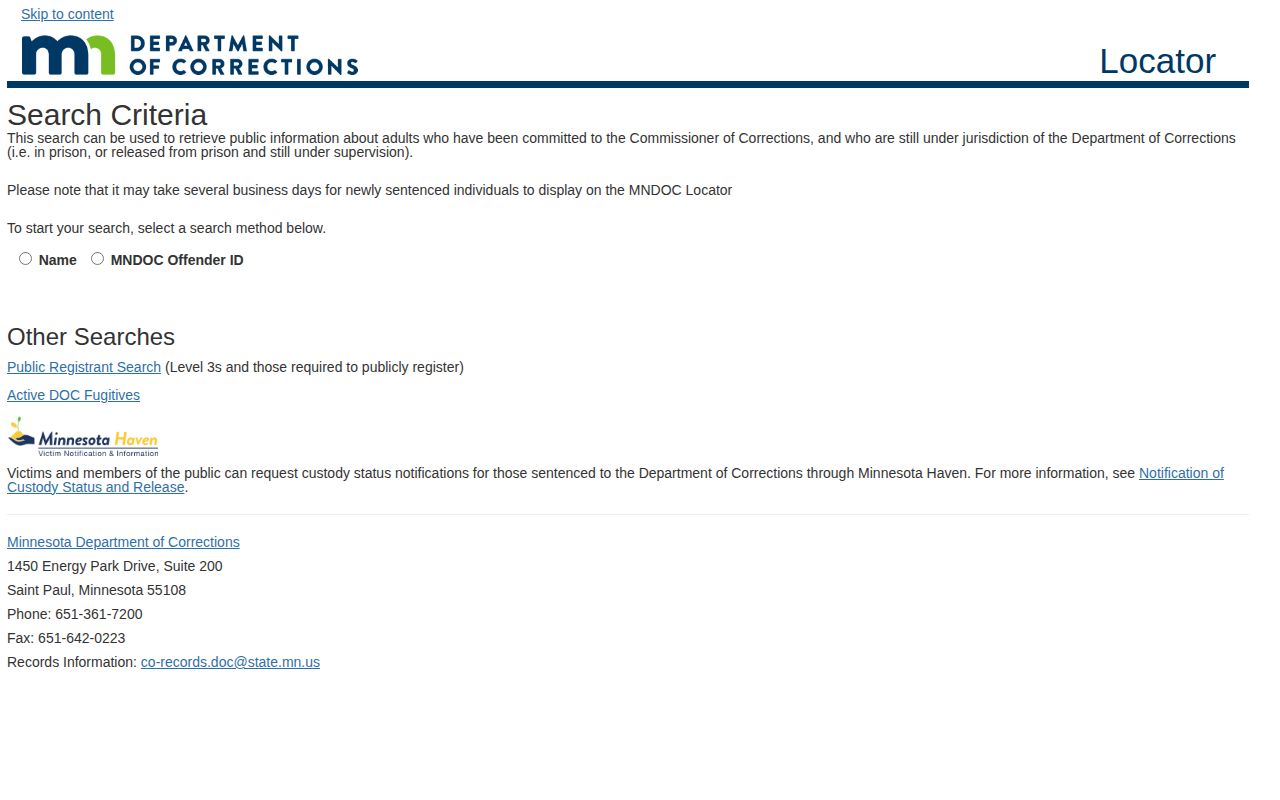
The captured screen documents the correct state-system entry point. Any individual result must be read in its current context because labels and jurisdiction can change.
Minnesota Haven, not county-jail VINE, is the state-prison notification program. It can provide eligible registered recipients notices about custody, release, agent assignment, sentence expiration, and supervision changes. The Victim Assistance Program number is 800-657-3830.
Prove Minnesota Prison Discharge
A Viewer result showing community supervision is strong evidence that prison confinement ended while DOC jurisdiction continued. It does not prove final discharge. Preserve the exact status, date label, DOC identifier, and retrieval time. If no result appears, vary the lawful identifiers and contact Records Management rather than declaring that the person never served a state sentence.
For legal-grade completion evidence, seek the actual discharge record, sentence-expiration entry, court discharge order, or legacy certificate of final discharge where applicable. Section 609.165 distinguishes discharge from release. Section 243.05 describes final-discharge records in legacy parole matters.
Also check for other custody. A state prison release can be followed by county detention, federal custody, immigration custody, or an active warrant. DOC departure proves only the DOC stage unless the receiving authority and later status are also checked. Record each agency transition rather than flattening the chain into one release date.
The court Register of Actions can supply sentencing, revocation, jail credit, and discharge events for a Douglas County case. MCRO is unofficial, and a certified order must come from Court Administration. A court event explains legal authority but may not match the moment DOC completed processing. Preserve both timestamps when that difference matters.
Supervised Release Board materials matter only for eligible cases. Its schedule page links current review schedules, agendas, and minutes, and older meeting material may stop appearing after its posting window. If a decision is missing, request the individual record from DOC rather than assuming the board never acted.
Earned incentive release is plan-based and eligibility-specific under sections 244.41 and 244.44. It is not a universal automatic reduction. Discipline or refusal of programming can add confinement, while multiple sentences and conditional terms can shift the apparent date. A website calculator cannot account for all those facts.
Section 244.05 also contains a calendar rule for covered cases when a release date falls on Friday, a weekend, or a holiday. Applicability depends on offense date and statutory terms. Read the current text and the individual DOC computation instead of promising an earlier or later day from the calendar alone.
Identity matching remains essential. Confirm a full name with a DOC number, birth information, or case number where lawful. Save a no-result only as “no MN DOC result under this spelling at this time.” Final discharge, scope, and spelling can each explain absence.
Notification is a different channel. Minnesota Haven serves eligible state-prison notifications and can provide notices about release, agent assignment, supervision changes, and sentence expiration. Minnesota VINE is connected to county jails and does not cover MN DOC prisons. Choose the program that matches the custodian.
Douglas County’s Alexandria felony office is the local adult supervision contact after many prison releases. Its address is 715 Elm Street, Suite 1060, Alexandria, and its main number is 320-335-5060. The office can route a lawful status question. It is not a jail and cannot replace institutional release records.
Public registries are also narrow. Minnesota’s Public Registrant Search covers only people who meet its legal public-notification scope, and the BCA noncompliant search covers noncompliant registrants. Neither is a universal prison release list. Presence may show a limited post-release status, while absence proves nothing about prison history.
If the Douglas County Sheriff records a transfer to DOC, pair that event with the first affirmative DOC status. This creates a custody chain from local detention into the state system. Later pair the prison release with community supervision and, when it occurs, final discharge. Each transition should retain its own date and source.
Corrections data can be partly private. Medical, psychological, security, informant, and other protected information may be withheld even when the basic public status can be disclosed. Ask for segregable public data and the authority for any redaction. Do not treat a limited response as proof that no record exists.
When requesting a past state release, give Records Management a narrow date range, the DOC number, the sentencing county, and the exact record sought. Ask separately for release, supervision, and discharge material. A focused request reduces identity mistakes and lets the agency locate existing records without being asked to invent a summary.
Keep the prison facility name as recorded. A person sentenced in Douglas County may move among Minnesota institutions before release, so the last prison is not necessarily the first receiving site. Facility movement records, release records, and the local court case each describe a different part of the custody history.
Note: Minnesota DOC status, a court disposition, and actual community presence answer different questions and may update at different times.