
Douglas County Parole and Probation
Minnesota uses several terms for community supervision. They are not interchangeable. Probation is a court-ordered status that may let a person remain in the community instead of serving all or part of a jail or prison term. Supervised release is the community portion of many executed state-prison sentences. Traditional parole remains relevant to legacy or other eligible cases, but the Minnesota Supervised Release Board does not decide the routine release of every person serving a determinate sentence.
A person may leave Douglas County Jail with no probation at all. Another person may be on probation without ever entering state prison. Someone released from a Minnesota prison can remain in the commissioner’s legal custody while living in Douglas County. Final discharge comes later and ends that correctional authority. The source and wording of the record matter more than a general label.
| Status | How it begins | Best Douglas County check |
|---|---|---|
| Probation | A court sentence or disposition places the person under community supervision. | Read the Douglas County court record, then identify the supervising office. |
| Supervised release | A state-prison sentence moves from confinement to a community term. | Check the MN DOC Public Viewer and the Alexandria adult felony office. |
| Parole | A legacy or otherwise eligible case receives release under applicable authority. | Use the DOC record and board materials for cases within board jurisdiction. |
| Final discharge | The sentence or correctional authority ends by expiration or an authorized order. | Look for a discharge order, DOC record, or legacy final-discharge certificate. |
- Supervised release
- The community part of a Minnesota prison sentence while DOC authority continues.
- Probation
- Court-ordered supervision that is distinct from release out of state prison.
- Absconder
- A person alleged to have stopped reporting or evaded community supervision.
- Discharge
- The later end of the sentence or correctional supervision, not just physical release.
Verify Douglas County Supervision
Begin with the system that imposed or now administers supervision. The MN DOC Public Viewer covers people committed to the commissioner who are still under DOC jurisdiction. That includes people in prison and people released from prison who remain under supervision. It does not serve as a complete archive after final discharge, and it does not prove that a person with only a Douglas County jail stay is supervised.
For a Douglas County court-based probation term, the Minnesota Court Records Online Register of Actions can show sentencing, probation, warrants, revocation, and discharge events. Online court information is unofficial. A certified order must come from Douglas County Court Administration when formal proof is needed. The broader Douglas County released-inmate search path helps separate jail release, a court event, and continued DOC authority.
- Match the person with a full name and a second stable identifier, such as a case number or DOC number.
- Search the MN DOC Public Viewer when the person served a state-prison sentence or may remain under adult felony supervision.
- Read the status and location labels literally. Community supervision confirms release from prison, not final discharge.
- Check the Douglas County court Register of Actions for probation, revocation, warrant, and discharge entries.
- Call the correct local office only after deciding whether the matter is adult felony DOC supervision or county and juvenile services.
- Ask for a written record if the exact status matters. Note the source, date, and terminology used.
Important: No result in one system does not prove that supervision ended. Spelling, final discharge, scope limits, or a different supervising authority can explain the gap.
Douglas County Supervision Offices
Douglas County has two offices that are easy to confuse. The Alexandria Minnesota DOC felony office handles adult felony probation and parole or supervised release. Douglas County Corrections describes juvenile probation, parole, state-contract functions, and court services. Neither office is a jail, and seeing a person at either address does not show custody.
MN DOC Felony Office, Alexandria
715 Elm Street, Suite 1060
Alexandria, MN 56308
320-335-5060
Fax: 320-762-0468
ICS/ISR agents: 218-846-0724
Douglas County Corrections
305 8th Avenue W
Alexandria, MN
320-391-5741
Juvenile and state-contract court-service functions
The official image below comes from the county’s adult felony supervision page.
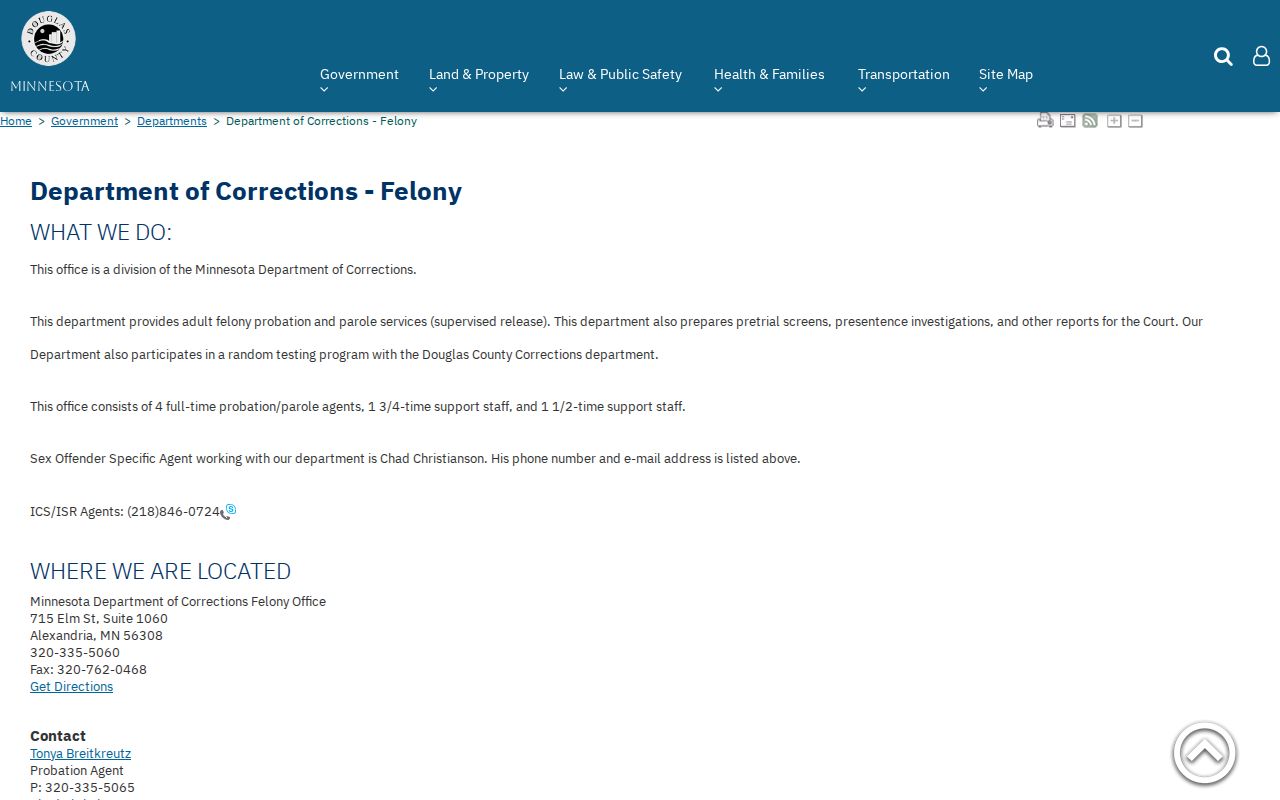
It supports the local routing details, but the office still cannot replace a court order or DOC status record.
Note: Confirm office assignment before visiting because a Douglas County address alone does not identify the person’s supervision type.
Douglas County Parole Board Reviews
The Minnesota Supervised Release Board became effective July 1, 2024. Its role is limited to defined eligible classes, including specified life, indeterminate, and certified cases. Most ordinary determinate sentences follow statutory release rules without an individual parole-board decision. That distinction prevents a routine prison release from being mistaken for a discretionary parole grant.
For a covered case, the official review schedule page links upcoming meetings, a changing Review Schedule PDF, agendas, minutes, and video. Posted past meetings may remain available for about 90 days. No separate searchable decision database was identified. Minutes are the practical public results path while available, and an older individual decision may require a DOC records request.
The official board overview is shown below.
The board may set a projected date, deny release, or continue review with directives, but it cannot authorize release before the applicable minimum.
For matters the board decides, Minnesota law calls for a majority decision and a grant or denial with an explanation within 30 days. A continuance can carry directives that must be addressed before the next review. Rescission or later action may also occur under the governing process. Eligibility varies by offense, sentence type, minimum term, certification history, and statutory exclusions, so no single first-hearing date should be applied to every Douglas County case.
Douglas County Supervision Warrants
A warrant or fugitive entry can arise after release. It does not state the original release date, and it does not prove that the person is now in custody. The MN DOC Wanted Fugitives page concerns people alleged to have violated supervision conditions and evaded authorities. Its listed 24-hour tip line is 651-603-0026. Treat each entry as a current allegation that needs verification.
Douglas County also maintains an Outstanding Warrants page. Fields can include age, issue date, bond amount when shown, reason, type, and number. The Sheriff warns that its list is current only as of the displayed date and that a listed warrant may already have been served. Current verification is available at 320-762-8151.
Douglas County Release Property
Post-release planning can include property still connected to a Douglas County Jail booking. The county says money and property are inventoried at intake, secured, and acknowledged on a signed property log. A person in custody may sign a Property Release for another recipient at the jail. The county does not permit the person to select only some items for that release.
Under the county’s stated process, everything other than original clothing and shoes must be released together. Evidence follows a separate path through the arresting agency. The property and money page does not expressly describe the final-exit procedure, so the jail should confirm what remains available and who may collect it. This practical issue is separate from probation or parole status.
Note: A signed property release proves permission to collect listed property, not discharge from jail or community supervision.
Douglas County Supervision Conditions
Douglas County supervision conditions come from the governing court order, release authority, or supervision plan. They may address reporting, travel, treatment, contact, or other conduct, but the exact order controls. A public status page should not be used to guess conditions. Likewise, a missed appointment does not establish a violation unless the responsible authority records or adjudicates it.
When a violation is alleged, the response can differ by supervision type and case. An agent may investigate, a warrant may issue, a court may hold a revocation hearing, or the board may act within its jurisdiction. These are separate events. A new Douglas County Jail booking can show present local custody, while the court and DOC records explain the supervision action that led to it.
Douglas County Final Discharge
Physical release and final discharge are different endpoints. Minnesota Statute §609.165 recognizes discharge by court order after a stay or when a sentence expires. For legacy parole, §243.05 states that the person remains in the commissioner’s legal custody until final discharge and provides for a certificate of final discharge.
The strongest proof is the document tied to the person’s case: a court discharge order, a sentence-expiration or DOC discharge record, or the legacy certificate where applicable. A projected date, a roster disappearance, an expired online meeting post, and a supervision-office address are not substitutes. If the DOC viewer returns no result, request an existing public status or discharge record rather than treating the blank search as proof.
Minnesota’s Data Practices framework permits access to public government data, but an agency need not create a new analysis. A narrow request should identify the person and ask for the existing document that records current supervision or final discharge. Private corrections, medical, security, juvenile, or investigative information can remain restricted. A lawful redaction does not change the meaning of the public fields that are released.
Note: Preserve the record’s literal term because “released,” “off supervision,” and “finally discharged” describe different legal stages.